Hemingway and Hadley's Poverty in Paris
A Moveable FeastHemingway and Hadley's Poverty in Paris was a daily condition of cold rooms, uncertain income, skipped meals, and close calculation, but it was not a condition Ernest Hemingway and Hadley Richardson accepted as their identity. They saw themselves as people who ate and slept well together, valued books and pictures over new clothes, and distrusted the rich. Their poverty imposed real limits; it also shaped the way Hemingway moved through Paris, observed its inhabitants, and understood the labor of becoming a writer.
Home, Comfort, and the Household Budget
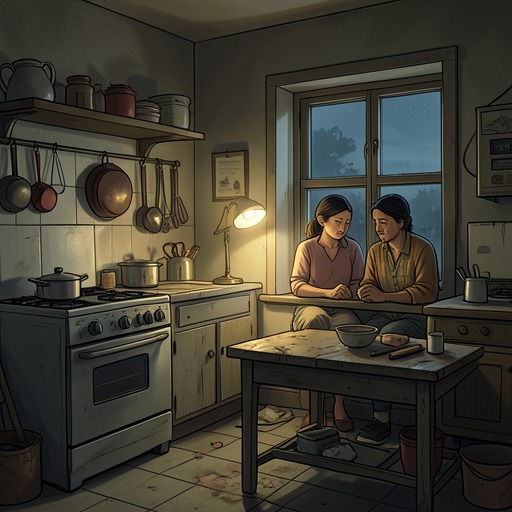
The rue Cardinal Lemoine flat had two rooms, no hot water, and no indoor toilet beyond an antiseptic container. Yet it had a fine view, a good mattress and springs for a bed on the floor, and pictures the couple liked on the walls. Hemingway found it cheerful, and its domestic value lay less in modern conveniences than in the things they had chosen to keep and enjoy. Hadley Richardson did not complain about the missing plumbing; Hemingway compared her patience with the way she had not cried over money when their horse Chèvre d’Or fell, though she had cried for the horse itself.
That patience did not mean he was unaware of what she wanted or of his own failures. He remembered being stubborn about money when Hadley Richardson needed a grey lamb jacket, and admitted that he had been wrong: after she bought it, he loved it. His recollection presents thrift as both a shared necessity and a source of friction, with the person earning satisfaction from work less troubled by deprivation than the partner sharing its consequences. He also recognized that his habits could make the struggle worse. In his accounting, the fight against poverty was often a fight not to spend, particularly when the money went toward pictures rather than clothes.
The practical costs of keeping warm could be daunting. On a winter day, Hemingway considered the price of a bundle of small twigs, packets of short split-pine kindling, and a bundle of hard wood for his top-floor workroom, six or eight flights up. He looked across the rainy street to see whether smoke was coming from the chimneys. Seeing none, he worried that the chimney might not draw, the room might fill with smoke, and the fuel money might be wasted. He walked on rather than risk the expense. The episode makes poverty concrete not through a dramatic crisis but through a decision about whether a fire would be worth attempting.
Food, Hunger, and the Uses of Scarcity
The couple's economy included skipped meals and a careful preference for inexpensive food and drink. Hemingway described how a young man supporting a wife and child could become intensely hungry, especially when surrounded by bakery windows and sidewalk diners. When he had left journalism and was not yet earning from the writing he wanted to do, he sometimes told Hadley Richardson he had been invited to lunch, then spent two hours walking in the Jardin du Luxembourg instead. The deception allowed him to avoid the sight and smell of food while preserving the appearance of having eaten.
Hunger became, for him, more than a financial hardship: it altered perception. In the Musée du Luxembourg, he felt that the paintings grew clearer and more beautiful when he was hollow with hunger, and that he understood Cézanne's landscapes better. He speculated, without certainty, that Cézanne might have been hungry or might simply have forgotten to eat. As he walked toward Sylvia Beach's bookshop, he chose a route with fewer food shops; by the time he reached it, his hunger was contained and his attention had sharpened. Sylvia Beach noticed his thinness and asked whether he was eating enough and what he had eaten for lunch.
The account does not romanticize deprivation as a substitute for food. After berating himself for complaining and for skipping a meal by choice, Hemingway went to Lipp's and ate slowly: a liter glass of cold beer, potato salad dressed with olive oil, bread, and cervelas with mustard sauce, followed by more beer. His appetite registers both the pleasure of the meal and the body that had gone without it. The episode also shows the limits of his self-discipline: he believed hunger could clarify perception, but he knew that eating was wonderful too.
At home, the couple made low-cost food and drink part of a deliberately satisfying domestic life. They could buy Beaune from a cooperative whose price was displayed in the window, eat a meal at home, read, and share a bed. Hemingway insisted that they ate and drank well for little money, slept warmly together, and loved one another. In Paris, he also described drinking quarter-, half-, or full-carafes of Cahors at the Nègre de Toulouse, usually diluted with water, and keeping inexpensive Corsican wine at home above a sawmill, where it too could be diluted. Skipping meals and avoiding new clothes could make room for occasional luxuries, but the underlying calculation remained visible.
Work, Income, and the Cost of Choosing to Write
Hemingway's finances were precarious partly because he had chosen to leave journalism in order to write work that American publications would not yet buy. In a conversation with Sylvia Beach, he worked out the modest possible return from The Transatlantic Review: at thirty francs a page, a five-page story every three months would bring 150 francs per quarter, or 600 francs a year. The arithmetic gives the hope of a literary income a hard scale. He could write the stories, but, as he saw it, there was no money coming in since he had quit journalism.
The choice to write was therefore both artistic commitment and household risk. Hemingway reproached himself for acting like a martyr when he had left journalism of his own free will; he knew that Sylvia Beach had lent him money before and might have done so again. He feared that accepting help, or compromising once, would lead to further compromises. His conviction that hunger could be useful coexisted with the plain recognition that he could have bought bread and eaten. The conflict was not simply between art and commerce: it was between a chosen working discipline and the needs of the people living with its consequences.
He also guarded the time and money needed to work. On a spring evening he wanted badly to go to the races, but judged that betting on horses—including horses he suspected of being stimulated—was no way for a young man supporting a wife and child to get ahead in the full-time work of learning to write prose. He describes himself as having foresworn the races and feels virtuous because he had worked hard instead. That resolve existed alongside the attraction of a potentially profitable wager, but the risk of losing money he could not afford made the choice consequential.
Walking the City and Finding a Way Through
Paris offered Hemingway a working geography of cheap routes, public spaces, and modest pleasures. When money was tight, he walked rather than spend on meals or transport. His excursions through the Jardin du Luxembourg, past the quiet square at Place Saint-Sulpice, and toward Sylvia Beach's bookshop allowed him to avoid some restaurants and food shops while keeping his attention occupied. The city was not an abstract refuge from poverty: the route itself was shaped by hunger, money, and the effort to continue working.
Other walks were a way to think and to observe people engaged in activities they understood. Along the quays, below the Pont Neuf at the head of Île de la Cité, he watched fishermen work the changing currents and backwaters of the Seine with long jointed cane poles, fine leaders, quill floats, and carefully baited lines. He knew several of the fishermen and sometimes bought wine, bread, and sausage, then sat in the sun with a book and watched them. He did not fish himself: he lacked the tackle, preferred to save for fishing in Spain, and could not predict when work would end or when he would have to leave. His interest in the fishermen was sustained without turning their practice into another expense or obligation.
The evening meal and the writing day could also be joined by walking. After paying his check, Hemingway crossed the rue de Rennes to avoid stopping for coffee at the Deux-Magots and took the shortest way home by way of rue Bonaparte, rue Guynemer, rue d'Assas, and rue Notre-Dame-des-Champs. At the Closerie des Lilas he wrote in a notebook with a café crème beside him. A payment from Germany meant that, for the moment, there was money; he expected that when it ran out, other money would come. The relief was temporary, but it enabled him to return to work.
A Shared Measure of Wealth
The couple's refusal to call themselves poor was not a denial of every hardship. Hemingway remembered cold, absent conveniences, missed meals, and the discipline of not spending. But they did not measure their lives by the standard of the rich. Sweatshirts worn as underwear seemed practical to them, if strange to wealthier people; books, pictures, inexpensive meals, wine, warmth in bed, and mutual affection counted as the substance of a good life. They could take a train for a cheap outing, pack sandwiches and wine, or imagine leaving the autumn rain for snow among the pines below Les Avants, where a modest pension would cost little more than their Paris expenses.
Poverty thus appears as a pressure that repeatedly enters intimate life and artistic work without wholly governing either. It determines what Hemingway eats, which streets he takes, whether he risks a fire, a horse wager, or a restaurant, and how he thinks about income from writing. Yet the narrative also gives weight to pleasures that scarcity cannot erase: a shared meal, a book carried along the river, fishermen bringing home a few fish, and the return to a notebook after a café stop. Their chosen sense of superiority to the rich does not remove material limits; it supplies a different measure by which those limits are endured.